Easy Grammar Ultimate Series: Grade 12+
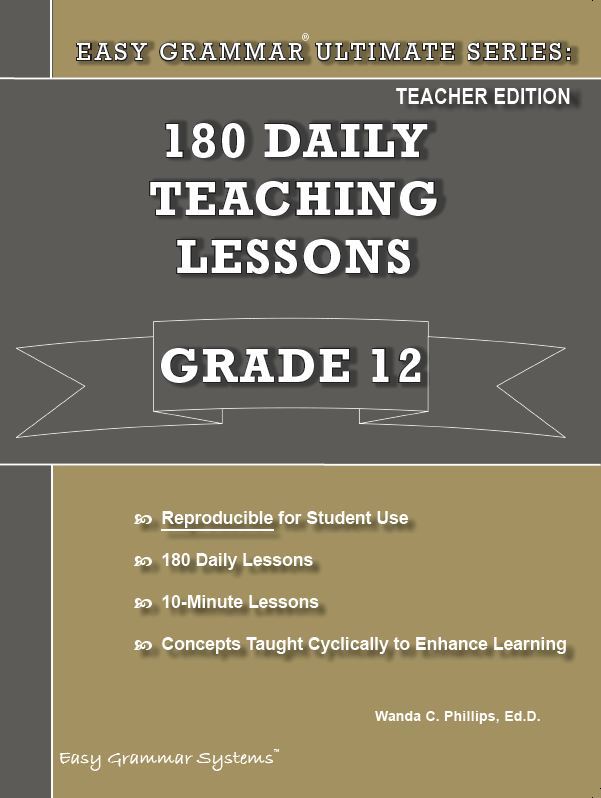
Easy Grammar® Ultimate Series: 180 Daily Teaching Lessons - Grade 12+ - PRODUCT #550 TEACHER EDITION
978-0-936981-550
- Content & Scope
- Reproducible
- 180 daily teaching lessons
- 10 minute lessons
- Materials presented in an easy, step-by-step approach
- Concepts build upon themselves
Note: This is a teaching text set up in 10-minute, daily lessons like other EGUS* texts. However, the concepts are presented include both basic and more complex rules for capitalization, punctuation, and grammar. Some concepts, such as catenative verbs, zero articles, and modal idioms, are introduced, but mastery is not required. A complete index for quick referencing is included. A section, "Beyond Easy Grammar," provides students with grammar’s 4 aspects: orthography, syntax, etymology, and prosody. (No written work is required in this section.) Dr. Phillips believes that this is a "must" for all high school seniors; they will want to take this text to college or to the work place as a resource. In fact, college professors may want students to obtain this text.
*Easy Grammar Ultimate Series
Format:
1. Capitalization teaching and application
2. Punctuation teaching and application
3 & 4. Grammar, sentence combining, and other concepts
5. "Beyond Easy Grammar"
— Orthography (Lessons 1-19) Sounds, syllables, words, and pronunciation
— Syntax (Lessons 20-76) Sentence structures
— Etymology (Lessons 77-173) Classification into parts of speech, derivation, and
modification of words
— Prosody (Lessons 174-180) Versification, the art of creating verse in poetry:
Major feet: Iambus (Heroic, Alexandrine, and Iambic)
Trochee, Anapest, and Dactyl
Q. What is the difference between Easy Grammar texts and Easy Grammar Ultimate Series texts?
A.Easy Grammar texts include Grades 2, 3, 4, 5, 6, and Plus. Grades 2-6 are for elementary students. Concepts are taught within sequential grammar units, beginning with prepositions. Using this approach, sentences are stripped to basics, enabling students to understand subject and verb and to build throughout each text.
EG Plus will give any student beyond Grade 6 a solid, basic understanding of grammar. It's especially popular because the text is written at a fourth-grade reading level. Therefore, students can focus on concepts. Like the other Easy Grammar texts, concepts are taught within sequential grammar units. Using a prepositional approach, sentences are stripped to basics for students to identify subject and verb and to build on more challenging topics such as subject-verb agreement, predicate nominatives, and correct usage in all areas.
The Easy Grammar Ultimate Series texts are similar to both Easy Grammar and Daily GRAMS. The texts are like Easy Grammar in that they are teaching texts. Concepts relating to phrases, clauses, compound-complex sentences, and other higher-level concepts (as well as basics) are presented in a 180 daily lesson format found inDaily GRAMS texts. Concepts are introduced, reintroduced, applied, expanded, etc. throughout each text. See the "Scope and Sequence" for each EGUS level: Grade 8, Grade 9, Grade 10, Grade 11, and Grade 12.
Sample Pages
A. The answers to the Easy Grammar Ultimate Series are only found in the teacher texts. You cannot purchase only the answers separately. Most people only get the teacher text if they only have one child to use the book. The student workbook is for people who have more than one child to use the book and don’t want to make copies.
Easy Grammar® Ultimate Series: 180 Daily Teaching Lessons - Grade 12+ Student Workbook - PRODUCT #567
(This student workbook does not contain the answer key and is to be used in conjunction with the teacher's guide.)
Note: You do not need to purchase this text if you are teaching one child. The student can write in the teacher text.
Easy Grammar Ultimate Series: Grade 12+ Tests - PRODUCT #796
These tests will give parents and teachers a way to assess their child's mastery of the concepts. The text is reproducible for student use.